
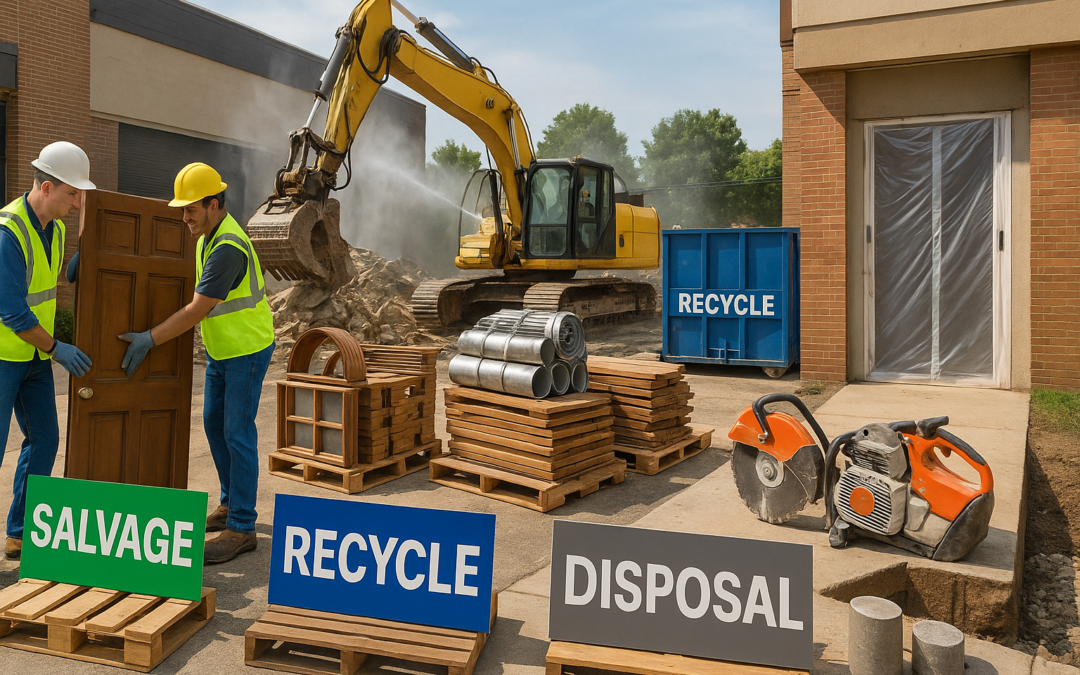
Deconstruction vs Demolition: Salvage, Recycling & Disposal Basics
Choosing deconstruction vs demolition is more than a budget decision—it sets your path for safety, sustainability, schedule, and how well your build-back runs. Below you’ll find a clear breakdown of salvage, recycling, and disposal, the real pros/cons, schedule impact, and how each choice supports renovation services, remodeling services, concrete services, and interior selective demolition on the same project.
Renovation Services & Remodeling Services
When planning renovation services or broader remodeling services, start with intent. Deconstruction removes components carefully: doors, fixtures, hardwoods, architectural metals, so they can be reused, donated, or resold. It reduces landfill, may unlock tax benefits, and often lowers tipping fees.
Demolition emphasizes controlled, mechanical removal to clear space quickly, keeping labor predictable and handoffs fast for framing, MEP, and finishes.
Interior Selective Demolition: Where It Fits in Deconstruction vs Demolition
Interior selective demolition lives between both worlds. It isolates the rooms or systems you’re changing ceilings, partitions, millwork, tile, limited slab cuts, while keeping surrounding areas operational and safe. Think dust control, negative air, protection of finishes to remain, and precise removal around live systems. In a hybrid plan, you might deconstruct high-value elements (millwork, doors, lighting) and then use targeted mechanical interior selective demolition for speed where salvage value is low.
Why it matters:
#1 Protects adjacent finishes so renovation services can start faster.
#2 Reduces rework and cleanup that eat contingency.
#3 Improves waste sorting for salvage/recycling logs.
#4 Keeps schedule predictable when other trades mobilize.
Concrete Services Interface: Sawing, Coring & Pour-Back in Deconstruction vs Demolition
Your concrete services plan should be defined before removal begins. On projects with slab trenches or MEP reroutes, crews will core, saw, and remove sections, then stage debris separately (clean concrete is highly recyclable). After utilities are inspected, pour-back restores thickness, reinforcement, and finish so flooring can proceed on time. Whether you choose deconstruction or demolition for the building envelope, aligning concrete services with waste sorting and inspection milestones prevents the costly “demo twice, pour twice” spiral.
Best practices:
- Map cut lines and depths on drawings and the deck.
- Separate clean concrete from mixed debris for recycling.
- Confirm rebar dowels, vapor barriers, and joint layout before pour-back.
- Schedule cylinder tests or surface prep early to protect the finish.
Hotel Renovation Services: When Deconstruction Beats Demolition

In hotel renovation services, guests and revenue windows drive decisions. Deconstruction is often favored for premium lobbies, bars, historical features, and high-value FF&E where salvage offsets labor. In back-of-house or repetitive guestroom scopes, a controlled demolition rhythm can be faster and more predictable. Many hospitality programs blend both: selective deconstruction of high-value areas, targeted demolition for speed elsewhere, and nightly turnover standards to keep floors on schedule.
Key levers:
- Phasing and swing rooms to maintain occupancy.
- Noise and dust windows aligned with guest patterns.
- Salvage tagging for resale/donation credits.
- Rapid interior selective demolition for typical rooms.
Choosing the Best Demolition Services: Pros, Cons & Schedule Impact
Owners frequently ask whether to hire the best demolition services first or lock in the best renovation services team to coordinate sequence.
The answer is alignment.
Model both paths, labor, salvage revenue, recycling rates, disposal fees, and general conditions, so you can see true schedule impact.
Deconstruction
Pros : higher salvage value, sustainability wins, potential donation credits, less mixed debris.
Cons : more labor hours, more staging, slower sequence.
Demolition
Pros : speed, simpler logistics, lower general conditions, quick start for build-back.
Cons: fewer items reclaimed, more disposal, recycling depends on local markets
Decision checklist:
- Target outcomes (speed vs. reuse vs. least waste).
- Salvage list with estimated recovery value.
- Recycling markets for concrete, metal, asphalt, clean wood.
- Disposal plan for mixed debris and hazardous items.
- Handoff milestones for MEP rough-in and finishes.
Deconstruction vs Demolition: Salvage, Recycling & Disposal Step-by-Step guide
- Pre-work survey & protections — Utilities located/isolated, barriers and negative air set, finishes to remain protected.
- Salvage first — Pull high-value items (doors, fixtures, hardwoods, metals). Photograph, tag, palletize, and log for donation/resale.
- Targeted removal — Use interior selective demolition where needed; deploy mechanical demo where speed is the priority.
- Recycling streams — Stage clean concrete, metal, asphalt, and cardboard separately. Track weights for sustainability reporting.
- Disposal last — Mixed debris is compacted and hauled; manifests retained for closeout.
- Site reset — Sweep, magnet sweep for nails, and verify elevations so renovation services can mobilize.
Services to Book
Move from planning into action with the right team:
- Demolition Services — Controlled structural and selective removal, haul-off, and recycling.
- Concrete Cutting & Pour-Back — Sawing, coring, slab removal, and restoration after trenching.
- Renovation & Remodeling — Turnover-ready phasing after selective demo, including build-back.
- Contact & Estimates — Scope reviews, schedule modeling, and waste plans for deconstruction vs demolition decisions. Connect with us!
Conclusion
Whether you prioritize salvage value, the fastest timeline, or the cleanest jobsite, mapping deconstruction vs demolition early, with clear streams for salvage, recycling, and disposal, keeps budgets and schedules on track. If you’re weighing interior selective demolition, coordinating concrete services, or lining up the best demolition services and best renovation services for build-back, the TCI team can help you model options and execute safely.
Get your plan moving at tciconstructionpros.com!